
Britain benefits from the summer sun as July smashes solar generation record
3 August 2026
Solar energy supplied more power to Great Britain’s grid in July than any previous month, while the sector continues to power ahead.
The figure of 14.4% of all power generated in July smashed the previous monthly record of 12.4%, set only in May.[1] In July 2025 – the best year for solar generation so far – only 9.6% of generation was from solar, according to data from the National Energy System Operator (NESO).
That means the sun generated a whopping total of 3.2 terawatt-hours last month.
Meanwhile, more solar installations of all kinds were completed in the first half of the year than any previous six months in the post-subsidy era. Across the UK, a total of 142,536 were recorded, according to official figures.[2] Most were on home rooftops, driven by the low cost of going solar and how it can slash domestic energy bills. Commercial-scale installations on the likes of supermarkets and warehouses would add more on top, but go largely unrecorded in the official figures as they are outside the planning system.
The number is second only to the record 167,316 logged in the second half of 2011.
Summer sun
On Sunday 12 July – amid dry and sunny weather conditions at the end of a heatwave – solar power accounted for 18.8% of Britain’s generation –almost breaking the record of 19.5% set on 24 May.
At peak, solar accounted for 44% of generation from 10.30am to midday that day, rising to a maximum of 15,427MW, says NESO.
The current record for power generated from embedded solar stands at 16.3 gigawatts, set at 12.30pm on 23 April this year. Maximum instantaneous performance tends to occur in cool, bright conditions, though the longer days of summer can mean more is generated over the course of the day.
Michael Shanks, Minister for Energy said: “These figures show that Britain’s solar sector continues to go from strength to strength, with electricity generation reaching a monthly record high last month.
“After two fossil fuel crises in five years, the lesson is clear: the more power we generate here in Britain, the less exposed families and businesses are to global energy price shocks. That’s how we deliver energy security, get bills down for good and deliver skilled jobs in every part of the country. Alongside expanding clean, homegrown power, we’re cutting VAT on energy bills, giving families more breathing space this winter.”
Chris Hewett, Chief Executive of Solar Energy UK said: “Fifteen years ago, solar energy was a footnote in the electricity mix. Now it is a major player, delivering home-grown, cheap, clean and reliable energy. It’s a success story that the whole nation should be proud of.”
Julian Leslie, Strategic Energy Planning Director and Chief Engineer at NESO, said: “These new records show the increasing power of solar. It’s hard to believe how far Britain has come over the past quarter of a century, with renewables now producing around 60% of our electricity – up from just 3% in the year 2000.
“Enabling low-carbon technologies like solar to play their part in our energy future is critical to helping us on our journey towards building a cleaner energy future.”
Annual record
Meanwhile, new statistics just published for 2025 confirm that solar generation was up by a massive 34.2% on 2024, due both to unusually long hours of sun and a leap in installed capacity.[3] That included the opening of the UK’s largest solar farm, the 373-megawatt Cleve Hill installation in Kent.
For an industry that 15 years ago this summer was celebrating its very first utility-scale development in Britain, this is a story of growth and increasing confidence to invest for the long-term in the UK. Britain is now reaping the benefits.
Before the old Feed-in Tariff system was introduced in 2010, solar photovoltaics held only 1% of renewable capacity. By the end of 2025, it had risen to over a third. The subsidy ended for new applicants in 2019.
Overall, renewable sources of electricity accounted for 52.1% of generation in 2025, only the second time this has exceeded 50% over a year.
The year saw the third-greatest increase in generation capacity, according to DESNZ, at 2,639 megawatts. The record stands at 4,309 megawatts, set in 2015.
Battery energy storage
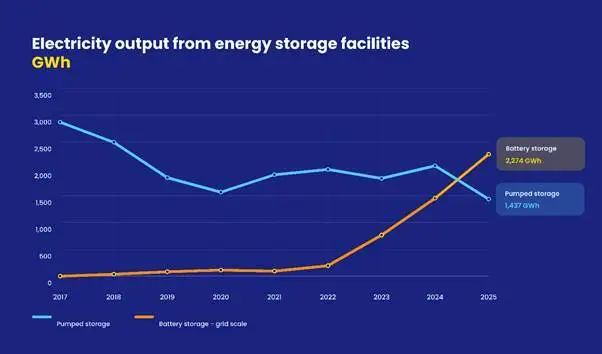
The new statistics also demonstrate how grid-scale battery energy storage systems (BESS) has become a serious player in the energy system, the first going online in 2018. Last year, the sector output more than pumped storage – the traditional way that electricity is stored.
The turnkey cost of BESS fell by around 40% between 2017 and early 2025, according to BloombergNEF. International Energy Agency data says that between 2010 and 2024, the dominant lithium-ion battery technology became 90% cheaper, offering longer service lifetimes, higher energy densities, too – driving a revolution both on the roads and on the grid.
Economic benefits
Together, the solar and BESS sectors have become an economic powerhouse, estimated to have generated almost £1.9bn for the economy in 2024, measured as gross value added, and employing 20,000 people.
By 2035, Solar Energy UK estimates that that the figures will be £3.5bn per year, with almost 43,000 jobs, having reached 90GW of solar capacity and 50GW of storage.[4]
[1] Historic GB Generation Mix - NESO
[2] Solar photovoltaics deployment - DESNZ
[2] Digest of UK Energy Statistics (DUKES) 2026 – DESNZ
[4] The Economic Impact of Solar and Battery Storage – Solar Energy UK