
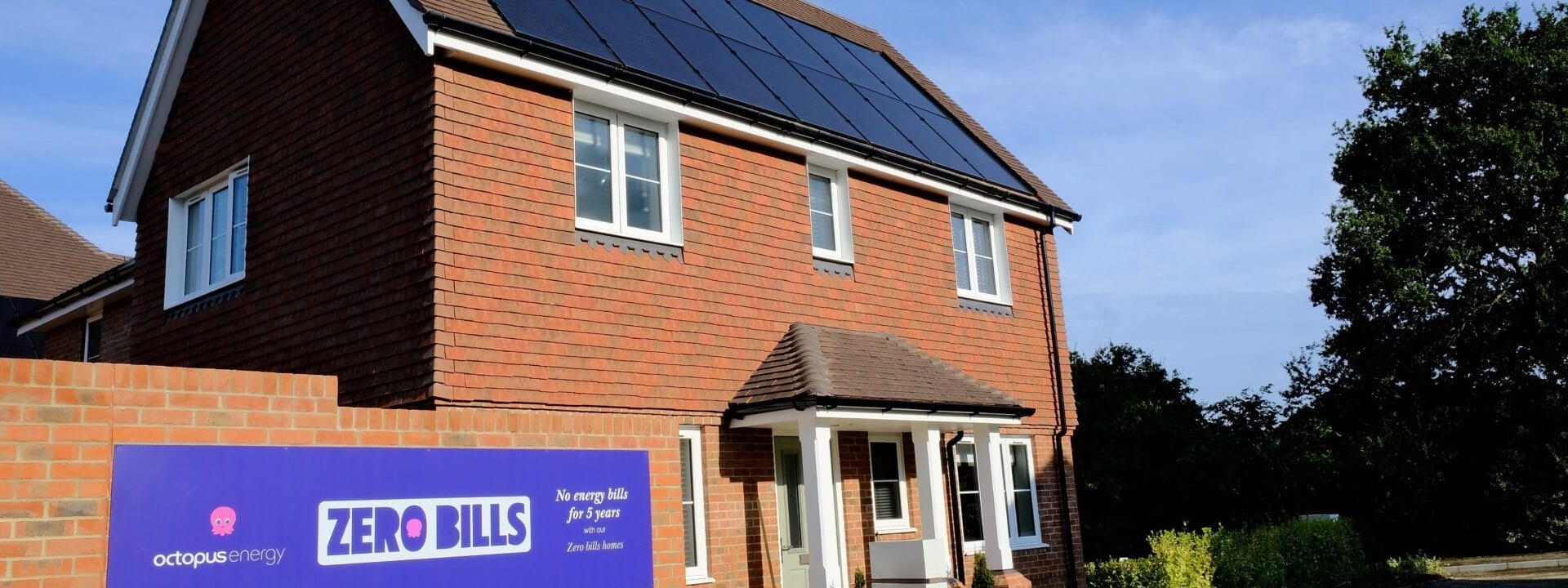
Build more solar homes, not fewer, industry tells Tories
5 October 2026
Solar Energy UK has questioned the Conservatives’ policy to abolish the Future Homes Standard, which supports the installation of solar panels on new homes.
“Everyone can see that solar and batteries are the quickest and most effective way for families to take back control of their energy bills. I would urge the Conservatives to reconsider abandoning a policy that they were instrumental in developing. It is far cheaper to design and build a new home with solar panels than having families pay to retrofit afterwards.” said Chris Hewett, Chief Executive of Solar Energy UK.[1]
“Like having carpets, a fridge or indoor plumbing, generating your own power from your own roof is part of modern living. I am glad to say that more than half of new homes are already designed this way due to the regulatory standards that are in force already.[2] Reversing course now makes no sense,” he added.
The price of housing is driven by supply and demand, with a small premium for newbuild. So lowering building costs would not change this – it would simply inflate housebuilders’ profit margins, to the public’s cost.
“From a broader perspective, the Future Homes Standard will help reduce reliance on imported natural gas by delivering decarbonised homes that are cheaper to run and freer from geopolitical impacts. Weaning ourselves off expensive gas is central to securing growth and protecting the economy from fossil-fuelled shocks,” Hewett added.
A Centre for Net Zero study, involving a randomized trial of installing 39,000 home solar and a battery systems cut net grid imports by 77% and bills by 62% over one year. They also cut peak-time consumption from the grid by 66% and still made a significant difference during the winter.[3]
Together, wind and solar power has saved the UK from almost £6bn of expenditure on gas since the Hormuz Crisis began, according to a recent analysis by Carbon Brief. Rooftop solar power, including on homes, is a critical part of that mix. The amount is equivalent to the load of 100 liquefied natural gas carrier ships.[4]
A recent survey by More in Common found that more than half of Britons have either installed solar panels on their home or would like to, with little variation between political inclinations.
The Future Homes Standard
The regulations enter into force on 24 March next year for most homes and six months later for flats. A transition period runs until 24 March 2028, after which projects without prior planning permission or the submission of initial notices must comply. The rules require homes to emit at least 75% lower carbon emissions than under the 2013 Building Standards, effectively prohibiting fossil-fuelled heating, while all but requiring solar panels to cover the equivalent of at least two fifths of the floor area.
The Conservatives appear to have not to have addressed the similar Future Buildings Standard, which applies to non-residential properties.
[1] The Future Homes and Buildings Standards: Building Circular 01/2026 - letter
[2] ‘An extraordinary achievement’: 2026 set for record solar power take-up – Solar Energy UK
[3]The Impact of Residential Solar and Battery Storage on Energy Demand and the Grid – Centre for Net Zero
[4]Analysis: Wind and solar save UK from gas imports worth £5.9bn during Hormuz crisis – Carbon Brief